
Technologies
Artificial Intelligences
Organizations are racing to adopt AI, but many lack the governance, data quality, and skills to scale it. Clear guidelines help minimize risks. However, to translate the potential of AI into real value, processes, roles, and governance models often need to be rethought. This article outlines Helbling’s methodology and shows how processes and roles can be deliberately redesigned with a focus on AI.
The need for a new Target Operating Model
Artificial intelligence – especially modern generative AI – is rapidly reshaping how organizations run their operations. Autonomous AI agents are making their presence felt in the enterprise space: 85% of companies expect to customize agents to fit the unique needs of their business, and close to three-quarters plan to deploy agentic AI within the next two years [1]. While earlier digital tools were mainly used to automate routine and well-defined processes, modern AI capabilities extend into higher-value work: analysis and decision support, content creation or communication tasks.
However, enterprises deploying AI agents face a core dilemma: Moving quickly while retaining confidence that it is safe to do so. The challenge is not the tools themselves, but refining the Target Operating Model to evolve into an AI-enabled organization.
Key components of a successful transformation
Technology is only one part of the equation; meaningful transformation depends on addressing several interconnected topics. Building on extensive experience with transformation programs and AI projects, Helbling has developed a methodology that combines technical expertise with business and operating‑model insights to provide clear guidance. The six essential elements of this approach are outlined below.
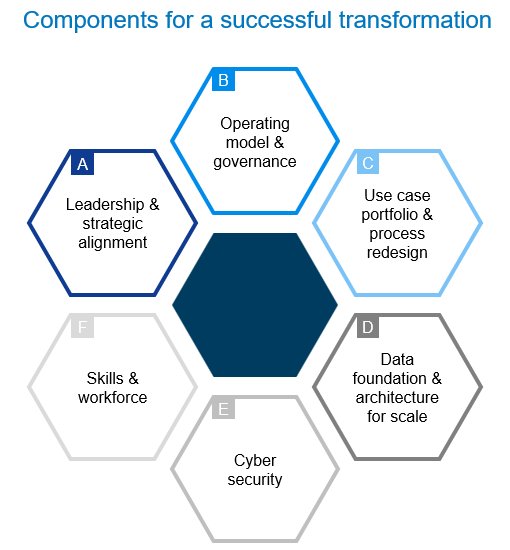
A) Leadership & strategic alignment
To fundamentally alter the core of a company, the transformation must be driven from the top. Strategic ambitions and decisions need to be taken and honestly communicated to enable the organization to advance and embrace the (potentially difficult) process of change. For example, strategic topics impacting tactical steps – such as building up internal resources vs. partnering and long-term data strategy that takes into account geopolitical risks and costs vs. revenue targets – must be addressed from the beginning to minimize avoidable costs later.
B) Operating model & governance
Once initiated, a transformation to an AI-enabled organization can only be scaled if trust in how AI is used across the organization is actively enabled. Strong governance to safeguard this trust – through clear accountability on management and other levels, robust risk management, transparency, and compliance – is key.
C) Use case portfolio & process redesign
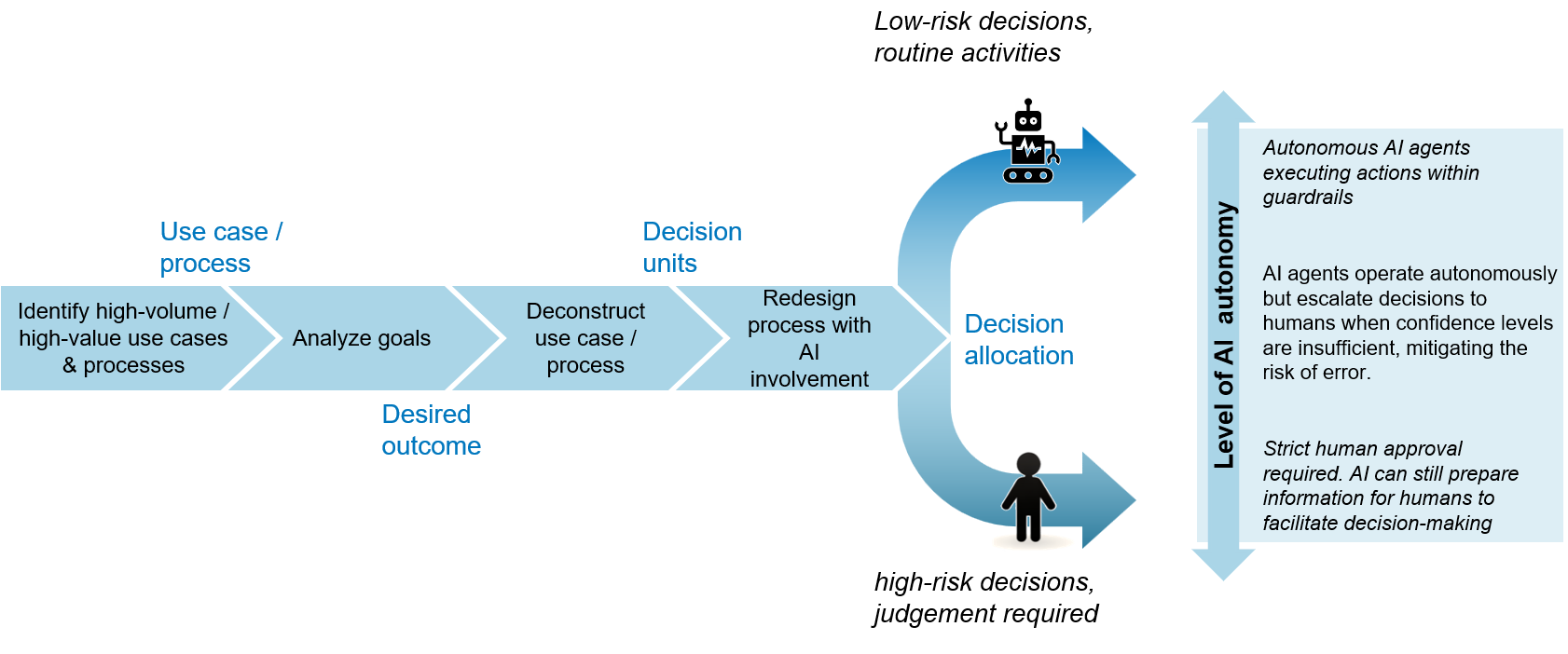
Selecting the right areas and use cases is a crucial first step, requiring a balanced assessment of financial impact and broader business considerations. High-volume or high-value areas often present the greatest potential to start with.
The goal is not to simply take people out of the workflow, but to redesign use cases around intelligent human-AI collaboration. This starts with a clear analysis of the desired outcome: Outlining feasible and meaningful goals, how and whether new processes can be made possible due to enhanced technological capabilities, whether certain processes become redundant as the goals can be achieved differently, etc. Next, each use case is broken down and allocated to smaller decision units, establishing effective AI integration where possible: At each step, the system is provided with the required information only, to prevent context pollution – a common challenge when working with AI agents. Getting the decision allocation between human and system right is an essential part of the evolution: Depending on risk and other factors, the level of autonomy for an AI system can vary significantly. Regardless, accountability remains with human experts, at least through their responsibility of defining and maintaining the appropriate guardrails, such as defined risk thresholds, quality controls, bias checks, or explicit escalation criteria. Human intervention is triggered by elevated risk levels. This may require upskilling employees to strengthen decision-making and exception handling, as EU requirements stipulate that high-risk AI systems must be designed to enable effective human oversight and timely intervention, for example [2].
D) Data foundation & architecture for scale
Trust determines how far and how fast AI can be scaled. But trust does not arise from data quality and accessibility alone – it depends on the ability to understand and trace decisions at any point in time. Before AI can be deployed broadly across an organization, companies must establish a trusted, accessible, well‑governed data foundation along with the corresponding architecture. This architecture must be designed not only for integrity and auditability, but above all for end-to-end traceability – the ability to fully understand why a system made a specific decision at a given moment. This requires capturing not just outcomes, but also decision paths, contextual information, and the data used. Only then can a robust foundation emerge – one that enables organizations to understand, debug, audit, and continuously improve AI systems, thereby building sustainable trust and resilience.
E) Cybersecurity
As AI systems become deeply embedded in operations and increasingly autonomous, security challenges intensify. While established security concepts such as the Principle of Least Privilege (PoLP) still apply, new risk categories must be addressed. Agents can be manipulated through prompt injection, and because they can trigger actions, this may translate into real operational incidents.
AI-enabled companies must adopt a governance-by-design approach: Agent behavior must remain observable, auditable, and explainable. Actions should be traceable and, wherever feasible, reversible to support effective oversight and remediation. Access to sensitive systems or high-impact capabilities must be governed by strict permission controls and explicit authorization mechanisms.
At the same time, AI is becoming increasingly proficient at analyzing and disassembling even obscure legacy software, accelerating automated vulnerability discovery for both defenders and attackers alike.
Organizations must move beyond data residency and address data sovereignty more holistically, ensuring that sensitive data is not only stored and processed within approved jurisdictions, but also remains subject to the necessary legal, regulatory, and governance controls. Against this backdrop, security by design becomes essential.
F) Skills and workforce
Organizations are increasingly adopting an approach that focuses on skills that can be dynamically combined across humans and AI agents. In this context, AI can make many jobs easier by taking over tasks that distract from the core objective. At the same time, it may also absorb some of the more interesting parts of the work (e.g., coding for software developers or analysis for knowledge workers). The challenge is to ensure that jobs do not become meaningless or uninspiring, by being reduced to supervising systems and making occasional decisions. Instead, organizations must do more than redistribute tasks between people and machines. They must actively invest in upskilling and reskilling, so AI enhances human work (by pushing boundaries) while preserving substance, creativity, and ownership.
Case study: Process redesign in practice
To illustrate what AI-driven process redesign can look like in practice, one of Helbling’s recent projects serves as a concrete example. In an oncology department at a Swiss hospital, physicians spend a great deal of their time identifying the most promising treatment option. There is huge value in reducing the time spent on research activities, so that physicians can focus more on direct patient care. Having identified the process, the next step was to understand the objectives: While identifying the most appropriate therapy was paramount, additional goals included the ability to justify off-label/off-limitation therapies through robust evidence when no other viable options exist. The overall workflow could be deconstructed into three core steps: 1) knowledge building, 2) literature search, and 3) documentation preparation.
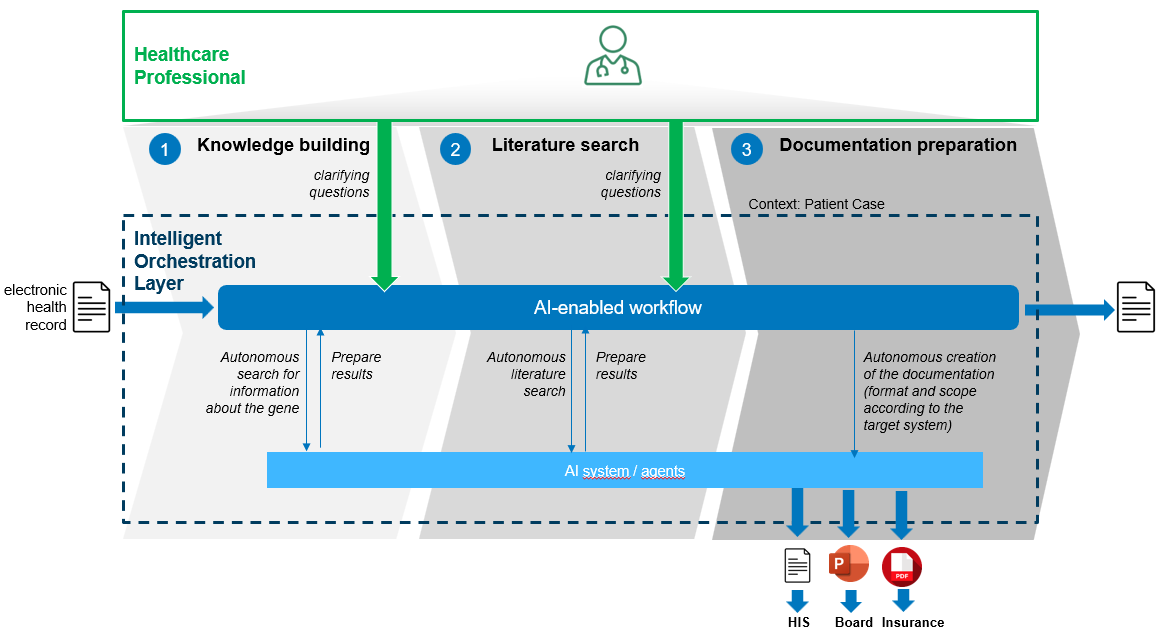
First, the physician seeks to understand the initial situation based on the molecular analysis. AI primarily acts as an assistant by displaying relevant content (images, descriptions etc.) from various data sources. At the same time, AI builds contextual knowledge, which becomes relevant in the second step, where the literature search is carried out autonomously.
The physician can verify the results any time using the cited references and, if necessary, request clarification or further specification until the proposal is clear, comprehensible, and convincing. In the end, human approval is required.
After the approval, AI prepares the required documentation tailored to each stakeholder: A Swiss health insurer requires different information than the tumor board, hence the system generates tailored PDFs, controlled by a human.
While in this example process redesign alone reduced time-intensive tasks from four hours to just a few minutes, it can also support upskilling junior staff, benefiting all parties involved. To achieve full operationalization of this process moving forwards, the dimensions outlined above are key and require further refinement. For example, sensitive health data requires a high degree of cybersecurity consideration, while governance processes in the hospital itself must be adapted to manage AI systems.
Summary: Organizations must learn to integrate AI responsibly and generate tangible value from it today to be prepared for the shift toward physical AI.
Looking ahead, Physical AI will define the next wave of transformation. It interprets the physical environment through multimodal inputs and translates them into actions e.g. through robotics, expanding AI’s impact from cognitive tasks to hands-on operational work.
As AI moves from the digital to the physical realm, the demands on organizations rise in parallel. First, the foundations need to be laid, before additional complexity is brought in. Helbling is your partner on this journey, combining cutting-edge technological expertise with operating model and process design depth.
Authors: Frederic de Simoni, Katrin Koller
Main Image: AI generated
Sources:
[1] Deloitte. (2026). From ambition to activation: Organizations stand at the untapped edge of AI’s potential, reveals Deloitte survey (Press release).
[2] Regulation (EU) 2024/1689 of the European Parliament and of the Council of 13 June 2024 laying down harmonized rules on artificial intelligence (Artificial Intelligence Act)